What OCD Actually Looks Like in Real Life (6 Stories)
Sep 02, 2026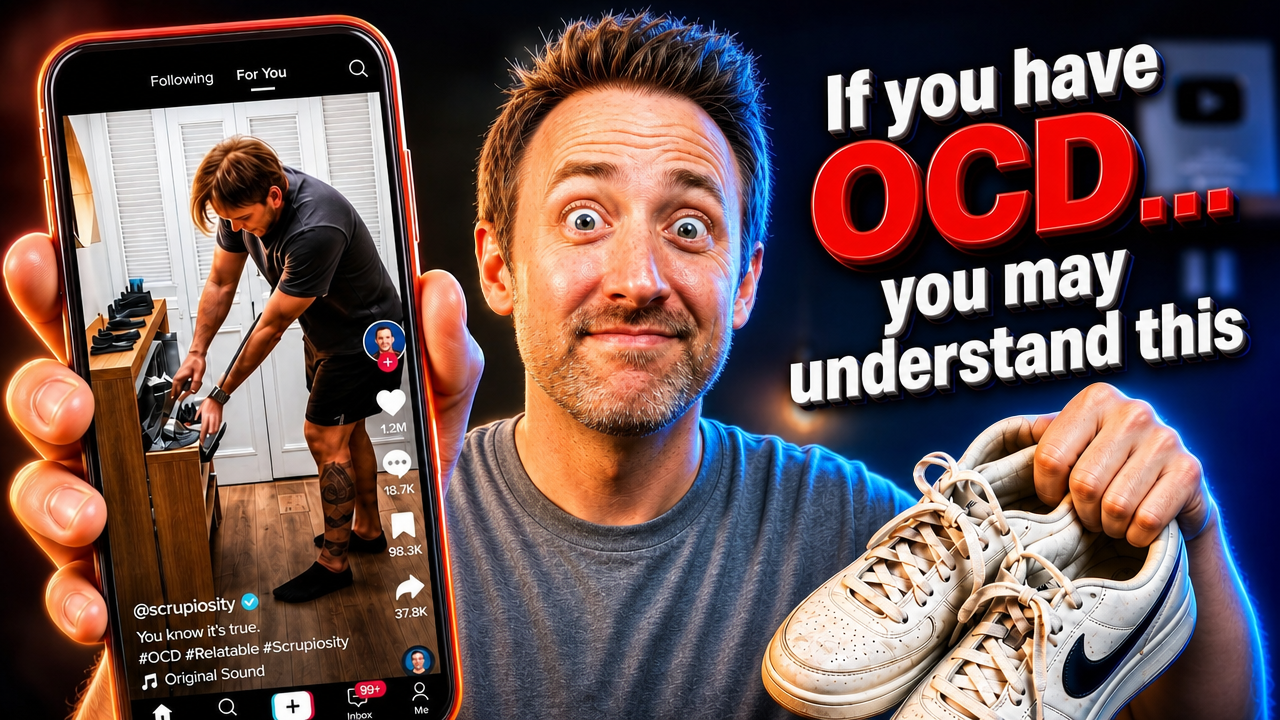
OCD shows up differently for everyone. In this post I'm reacting to real people describing what OCD actually looks and feels like in their day-to-day life, and sharing what the treatment looks like for each one.
If any of these sound familiar, you're not alone.
STORY #1
Just Right OCD and Magical Thinking: "I put my shoes in and it didn't feel right"
Something has to feel right. I put my shoes in, it didn't feel right, so I have to do it again. And it's not just shoes — it's walking through doorways, tapping light switches, adjusting the volume knob in the car. If something doesn't feel right, the brain says: go do it again.
Sometimes it's just right OCD — a feeling of incompleteness with no specific threat attached. Other times there's magical thinking layered on top: if I don't tap this thing three times, something bad will happen. Maybe your mom gets in a car crash. Maybe you fail the test. The specific threat can be completely random, but the brain treats it as urgent.
And it seems minor at first. Takes a few seconds. Not a big deal. But it adds up and compounds over time until it's taking over entire mornings.
Treatment: Mess it up on purpose. Put the shoes in wrong. Walk through the doorway and keep going. Don't tap the switch. "Love this feeling. Hope it lasts all day. I'm not going back."
STORY #2
Scrupulosity OCD: The Urge to Confess Everything
This person described feeling like they're lying or being immoral if they don't confess things constantly, to family, to friends, to church leaders. Feeling guilty about changes they've made in their own identity. Feeling like a horrible person if they keep anything private.
This is scrupulosity OCD. And it's complicated when it's tangled up with real life changes like evolving beliefs or shifting identity. Some of that questioning is completely normal. The OCD piece is the intensity of the urge, the anxiety that comes with not confessing, and the fact that confessing once never fully resolves it. You share one thing and immediately feel like you need to share more context, more detail, more reassurance.
A feeling isn't always a reliable signal either. I feel like a horrible person is not evidence that you are one. OCD attacks what you value. If being a good person matters to you, OCD will use that against you.
STORY #3
Need-to-Know OCD: "I have to go back and read the full song title"
Skipping songs in the car, and suddenly: I didn't fully read the title of that song. Have to go back, back, back until finding it, reading the full title and artist name, then moving on. The urge feels impossible to ignore.
This is related to need-to-know OCD and sometimes called memory hoarding. The brain says: I need this information. I might need it later. I'll feel anxious if I don't have it. So people end up with pages of notes saved on their phones, information written down that they know rationally they'll never need — but they did it and they felt better, so the brain learned to do it again.
Passing a billboard and not finishing reading it? Turn around. Go back. The brain can come up with the most random compulsions to feel comfortable.
Treatment: Find the trigger on purpose. Listen to a song, glance at the title for a second, skip it. Sit with the feeling. "Love it. Hope it lasts all day. Never going back to that song." Any threat — maybe, maybe not. Do it again. Do it again.
STORY #4
"I don't remember things I should remember"
Someone described telling their therapist: I have conversations and the next day I can't remember the details. Things I should remember, I just don't.
The reason: when you're ruminating, you're there physically but not mentally. You're at the beach with your friends, you're in the conversation, you're doing the things — but your brain is somewhere else, looping. So of course you don't remember the details. You were never fully present for them.
This isn't a memory problem. It's a presence problem. And it's one of the quieter ways OCD takes time from people's lives.
What helps: When you catch yourself mid-rumination, use your five senses to come back. What do you see? What do you hear? What are you eating? What can you feel in your hands? Five unique sounds. Be in the moment, not the loop. The thoughts can be there — just don't follow them.
STORY #5
Contamination OCD at School: Can't Stop Thinking About It
You walk into school. Touch a door handle here, there. Someone coughed near you on the way in. You sit down and something feels off. The teacher is talking but your brain is stuck: what's my hand doing? Is that person sick? They talked about a parasite recently. Should I go wash my hands now or wait? Is this actually dangerous?
The teacher keeps talking. You have an hour and a half left. And your brain is just running and running and running.
People describe losing time this way. Missing entire conversations. Missing entire experiences. Not because they wanted to — because OCD took over the mental space where presence would have been.
"Maybe my hand is contaminated. Maybe I got the parasite. Maybe. Maybe not. I love the feeling of this chair. Let me listen to the voice of the person talking to me. Five unique sounds. What can I touch in my hands?" Be present while the thoughts are there. The more you try to engage with them, the more stuck you get.
STORY #6
"He brought the entire silverware holder so I'd know he hadn't touched my spoon"
A partner bringing ice cream in bed along with the whole dishwasher silverware holder, because he knows if he touches her spoon it might become a problem. So he just brought everything.
You love them. They love you. They just want you to be able to eat your ice cream in peace. It's hard to fault anyone in this situation.
But accommodation — when loved ones adjust their behavior to work around OCD — tends to strengthen it over time. The world gets organized around the compulsion instead of the compulsion getting treated.
If you want to work on it: tell your partner what you're doing and why. Set up the exposure together. Four spoons, one of which I touched. You pick one, I'm not telling you which. Now eat the ice cream. Maybe I touched it, maybe not. Maybe there's something on it, maybe not. We're willing to sit with that and be okay.
OCD Takes Many Shapes
Shoes that have to feel right. Confessing to everyone you love. Going back to read a song title. Losing an hour of your day to a thought loop you couldn't get out of. A partner bringing the entire silverware holder to avoid triggering you.
Every single one of these is OCD doing the same thing in different costumes. And ERP treats all of them the same way. Find the trigger, change the response, resist the compulsion, do it again.
The Master Your OCD course covers all of these themes with step-by-step ERP for each one. You can try it free.

Nathan Peterson, LCSW — Licensed therapist specializing in OCD, anxiety, and related conditions. Nathan has helped thousands of people through evidence-based treatment and education.
LCSW Licensed Therapist | 10,000+ Course Students | 24M+ YouTube Views | Penguin Random House Author
 |
Recognize your OCD here? Let's treat it.Master Your OCD covers just right OCD, scrupulosity, need-to-know OCD, contamination, and every other subtype with step-by-step ERP from home.
|
Author