4 things to do instead of "CALM DOWN"
Apr 15, 2026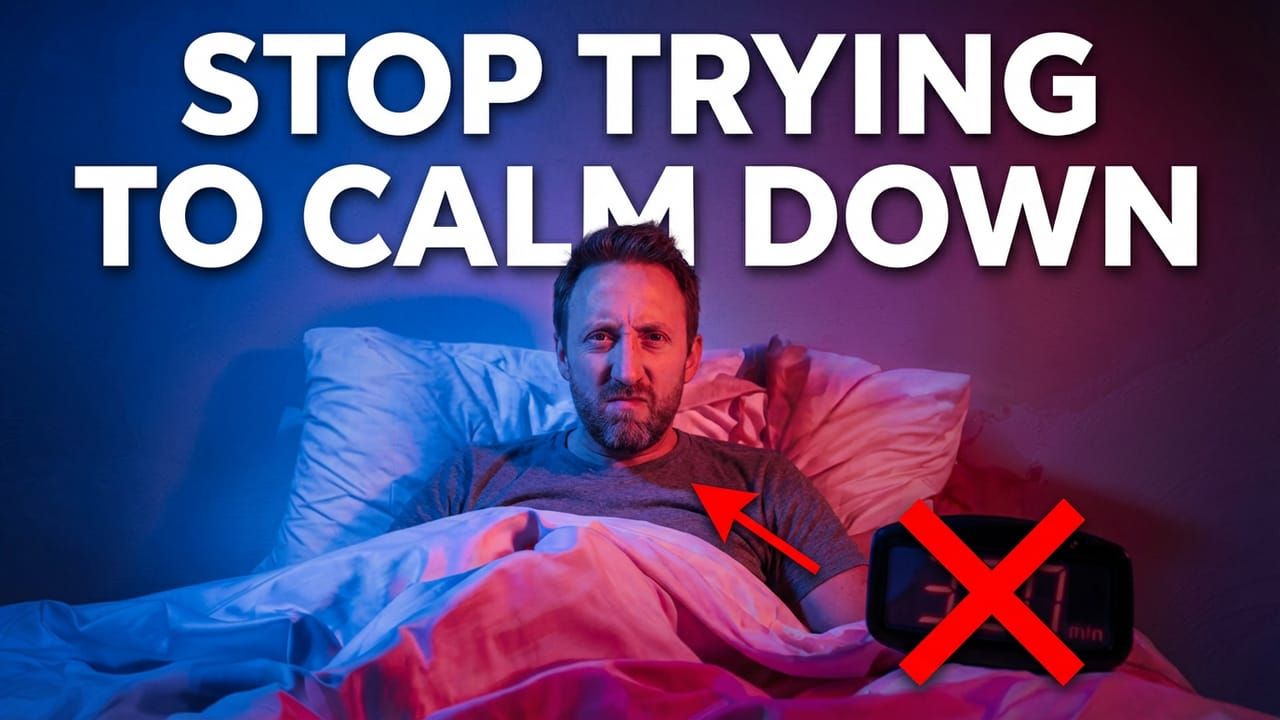
Stop Trying to Calm Down: Why It Makes Anxiety Worse
Stop Trying to Calm Down: Why It Makes Anxiety Worse
Your therapist told you to take deep breaths when anxious, but it's making your anxiety worse. Learn why trying to calm down teaches your brain that anxiety is dangerous and discover the 4-step system to stop chasing calm.
The Problem With "Just Calm Down"
Your therapist told you to take deep breaths when you're anxious.
Your mom says, "Hey, just calm down."
Every anxiety app on your phone says, "Do some meditation."
But none of it works.
Actually, it's making your anxiety worse.
Because every time you try to calm down, you're telling your brain:
"This feeling is dangerous, and I need to escape it."
What Actually Happens When You Try to Calm Down
Here's the typical cycle:
- Your heart races
- You take deep breaths
- Maybe you do progressive muscle relaxation
- You try to meditate
- For a second, maybe it works—your heart rate drops, you feel better
But What Did You Just Teach Your Brain?
- That the racing heart was dangerous
- That the anxiety was a threat
- That you needed to escape it
So next time your heart races, your brain panics harder:
"Oh no, it's happening again. Quick, make it stop. What did you do last time? Do that thing again."
Relaxation-Induced Anxiety: What the Research Shows
This phenomenon is called relaxation-induced anxiety.
Research has shown that a high percentage of people experience it.
Studies from the 1980s all the way to now have found essentially the same thing:
The more we try to force relaxation, the more anxious we get.
Why Does This Happen?
Not because trying to be relaxed is broken.
It's because we're using the wrong strategy.
You're chasing calm like it's the goal.
And that pursuit actually creates a whole new layer of stress.
Now you're anxious about being anxious.
Every relaxation technique becomes another way to avoid a feeling instead of actually sitting with it.
What to Do Instead: Stop Trying to Calm Down
What if you tried NOT to calm down?
What if you tried NOT to figure out what the sensations mean in your body?
The heart rate. The heavy breathing.
I know your brain is screaming: "Danger! Calm down! Danger!"
The Alternative Response
Instead of deep breathing to make it stop, you say:
- "Cool. My body is ready for something amazing."
- "This is extra energy I've got here."
- "I don't really need to calm down right now."
- "I'm going to let my body do its job."
You're not fighting it. You're reframing it as neutral or even helpful.
Understanding Anxiety as a False Signal
We're supposed to feel anxious when we're in immediate danger.
Our body is designed to protect us.
But when we're feeling anxious and there's nothing around us that we can see—they're often false signals.
And we have to treat them as such.
Here's the Reality
Your body freaking out isn't the enemy.
It's the way you're responding to it that keeps it alive.
Did you know we feel "anxious" when we're:
- Happy
- Excited
- Working out
We can feel anxious all over the place because we've just got this extra energy and our brain wants to hold onto it.
The sensations are the same. The difference is the story we tell ourselves about it.
The 4-Step System to Stop Chasing Calm
Step 1: Name It Without Judgment
When you're feeling anxiety, name what's happening in your body out loud if you can:
- "My heart's racing."
- "My chest feels a little tight."
- "I'm feeling jittery."
- "My brain just feels a little foggy."
That's it.
Not: "Oh my goodness, this is terrible."
Just describe it.
Imagine you're watching yourself on stage—someone who's anxious. How would you describe what they look like?
That's you. You are just observing.
Why Does This Work?
When you name a sensation without attaching fear to it, you're creating distance.
You're not IN the anxiety—you're noticing the anxiety.
Your brain was expecting you to panic. Instead, you just observed it.
That's new information for your nervous system.
Step 2: Relabel It
Take your body sensation and relabel it:
Instead of: "Something is wrong"
Say: "My body is activated right now. I could use this in some way or another."
You're not lying to yourself.
You're just removing the catastrophe interpretation of "something's wrong, I've got to figure it out."
The anxiety doesn't disappear—but that's actually the point.
Our goal isn't to get the anxiety to go away.
It will eventually, but that's not our goal. We're not searching for calm.
Step 3: Respond (Don't Calm Down)
You've named it. You've relabeled it.
Now here's where the real work happens.
Instead of trying to make it stop, you respond in one of two ways:
Option 1: Agree With the Threat
- "Yeah, man. Hope my heart races all day. That would be amazing."
- "Something bad's going to happen? Sweet. Awesome. Sure hope so."
- "Hope anxiety never goes away. This is amazing."
It's a total lie, but it doesn't matter. We're agreeing with it.
Option 2: Embrace the Uncertainty
- "Maybe something's wrong. Maybe not. Don't care."
- "Maybe I'll pass out. Maybe I will. Maybe I won't."
- "Maybe I'm actually in danger. Maybe I am. Maybe I'm not."
You pick whichever makes your anxiety more angry in the moment.
The goal is to take the urgency away from it.
Your brain says: "Wait, why aren't you fixing this right now?"
Write Down Your Game Plan
Right now, grab a notepad or your phone.
Write down the physical sensation you're most afraid of when you're feeling anxious:
- Is it your racing heart?
- For me, it's blood rushing through my body
Write this down and come up with a game plan.
Next time this hits, you're NOT reaching for the breathing app.
Write down your statement:
- "I hope this gets worse."
- "I love that feeling of blood rushing through my body."
- "Come on, give me more of this."
Then keep doing whatever you're doing: making breakfast, working, watching TV, playing a video game.
The exposure is staying with the sensation and removing the urgency.
Step 4: Keep Living Life
No matter how you're feeling, you're functioning.
If you're functioning badly, then function while you're shaking.
- Function while your heart's pounding
- Function even though you feel like you're going to die
- Function even though something bad feels like it's going to happen
You keep moving forward anyway.
It's Not About Performing Well
It's about proving to your brain: "I can do tough things even while feeling anxiety."
When your brain says:
- "You need to calm down before you send that email" → Send it anyway while anxious
- "You can't go to the store feeling like something bad's going to happen" → Go anyway
- "You need to sit down and breathe" → Keep standing. Keep moving. Keep going.
The Exposure Is NOT Doing the Compulsion
The thing you're doing to try to protect yourself, to keep yourself safe.
But what are you keeping yourself safe from?
Where's the danger?
Danger is not just a thought in your head that says "it's a potential whatever."
You've got to see it.
You're not waiting for this feeling to pass.
You're not problem-solving how to stay calm (that's the trap).
"So I Should Never Do Deep Breathing?"
No. Here's the test:
Ask yourself: "Why am I doing it right now?"
If You're Doing Deep Breathing to Make the Anxiety Stop:
That's a compulsion.
You're teaching your brain that this feeling is dangerous.
If You're Doing Deep Breathing as a Daily Practice:
Keep doing it. It's a skill.
Example
Box breathing every morning to start your day? Cool. Fine. Learn it.
Box breathing during a panic attack because you're desperate for relief? That's telling your brain you need this to feel better.
Instead
"I love this feeling, man. My chest is tight. My breathing—I love this. Hope it lasts all day."
It doesn't automatically make everything go away.
You're not calming down. You're staying with the anxiety.
And that, long-term, is teaching your brain to not have as much panic or anxiety.
You've retrained your brain to say "Not a problem. Not a problem"—without actually saying "Not a problem."
The Bottom Line
Unless you can 100% see that there is danger right in front of you—there is no question whatsoever—let's treat it as a false signal.
Everything can be a "what if."
I don't know. Anything's possible.
But I'm going to keep moving forward anyway.
And I'm going to use responses as if I just don't care:
- "Whatever."
- "Cool."
- "Awesome."
- "Hope it lasts all day."
Stop chasing calm. Start staying with anxiety.
That's how you retrain your brain.
Nathan Peterson, LCSW
OCD and Anxiety Specialist
Creator of "OCD and Anxiety" YouTube Channel
Developer of Master Your OCD Online Course
Author