Can you be successful with OCD?
May 13, 2026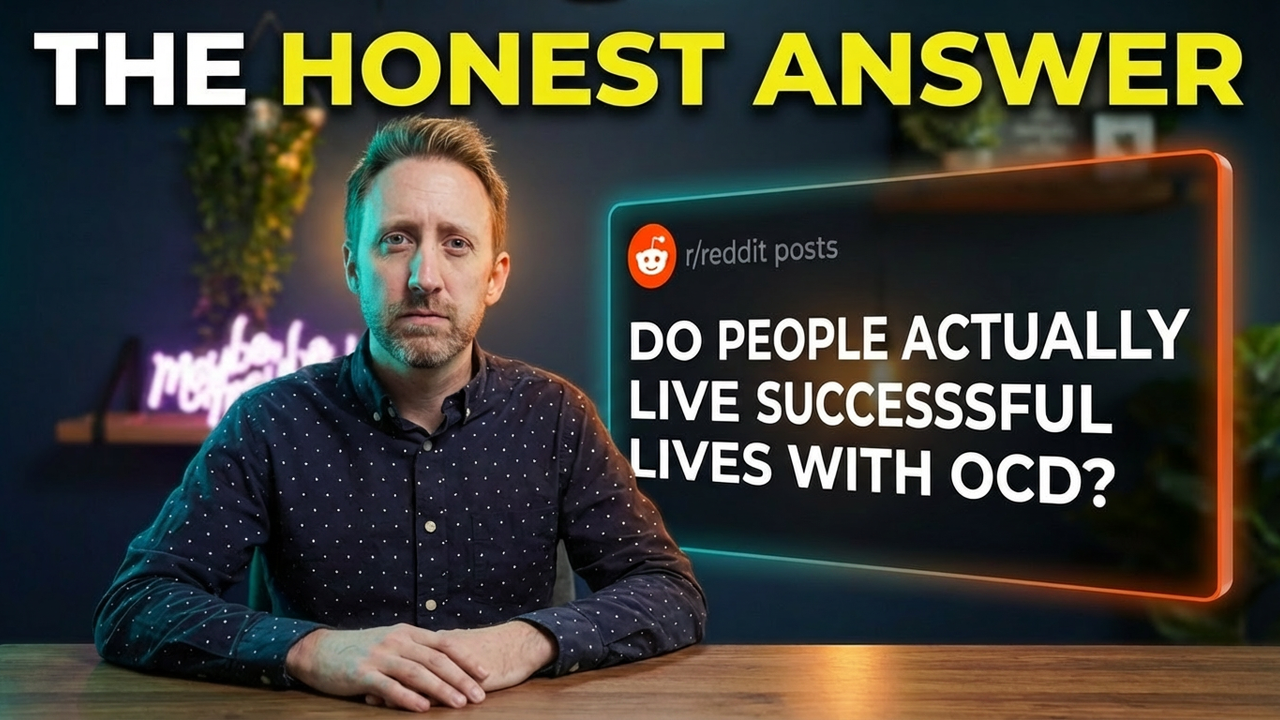
Reddit is where people say things they wouldn't say anywhere else. The OCD communities on there are raw, honest, and often ask exactly the questions that don't get answered in clinical settings.
I went through a bunch of them and gave my honest reactions — as both a therapist who specializes in OCD and someone who has dealt with anxiety personally. Here's what came up.
QUESTION #1
"Do people actually live successful lives with OCD?"
Yes. Full stop. There is nothing that is actually stopping you.
People wait sometimes for their OCD symptoms to go away before they get the next job, before they go to college, before they get married, before they have kids. But OCD doesn't wait. And you don't need to wait either.
The people who are successful are the ones saying: "Despite my OCD, I'm going to go do this thing." They figure it out along the way. They do exposures when they need to. They keep moving.
Success is what you make it. OCD is a factor in your life — it doesn't get to be the deciding one.
QUESTION #2
"Is anyone else persistently guilty about everything?"
That feeling of just waiting — like something is wrong. Like someone is about to reach out and say you did this wrong, you are guilty.
Even if you're just sharing an opinion, moving through your day — you can feel guilty about anything. This is one of OCD's favorite hooks because guilt feels meaningful. It feels like your conscience speaking. But for a lot of people with OCD, guilt is a false signal — just like anxiety.
The treatment response is the same: "I love this feeling. Thank you for being here. You're welcome to join the party all day if you want." Not because you actually love it — but because responding that way takes the power away from it.
Feel guilt — but respond differently to it. Don't avoid life because of it. Keep moving forward, guilt and all.
QUESTION #3
"What were some of your stupidest past compulsions?"
Someone wrote: "It was brief, but I had to blow a bubble with soap whenever I washed my hands. I couldn't go without it."
The brain creates its own rules. You have to do this. It doesn't make sense, but you have to do it — or you'll feel wrong, or uncomfortable, or like something bad will happen.
In treatment, we figure out what the brain is saying will go wrong if you don't do it — and then we risk it. We don't do the compulsion. And we sit with the discomfort. And it passes.
Also worth asking: do you have to do it — or are you choosing to? Because you actually have a choice. It's going to feel uncomfortable. But that discomfort is temporary. The compulsion just delays it.
QUESTION #4
"Do any of you have problems with numbers?"
More common than people think. This usually shows up as magical thinking OCD — the brain attaches meaning to specific numbers. The temperature in your car can't be a certain way. The radio can't land on a certain station. If you see the number, you have to look away.
Here's the treatment: whatever number you're avoiding becomes your best buddy. You write it down over and over. You cut them up and put them in your pocket. You hand them out. You make it your favorite number.
It's not a problem unless you make it a problem. The goal is to tolerate the uncertainty — maybe something bad will happen, maybe not — and keep living anyway.
QUESTION #5
"Does anyone else have a fear of going to jail with OCD?"
You should only have this fear if you actually did something wrong and you're hiding in the shadows. But that's usually not what OCD is about. It's the smallest little thing — something questionable from your past. Not jail-worthy. But OCD takes it and runs.
One approach that works well here is script exposures. You write a first-person story: the police show up at your door, they found your search history, they're taking you in. You read it over and over without performing any compulsions afterward.
Or you take the value away from it entirely: "Hope I go to jail. Free food. Someone else makes dinner. A roommate to talk to. Sounds amazing." You don't have to believe it. The point is to stop treating the fear like an emergency that needs to be solved.
QUESTION #6
"Playing video games with OCD — I feel like I have to check every nook and cranny and it strips the fun out of it"
OCD attacks what you care about. You love video games — so OCD figures out how to mess that up for you. The fear of missing something important. The need to watch every tutorial. The checking.
The exposure: turn the game on. Play it. When you see something shining in the corner that you could go pick up — walk the other way. Maybe it was important. Maybe I'll think about it the whole game. Amazing. Sit with it.
There's a lot of strength in doing what you want to do and letting OCD tag along without letting it drive. You can play the game. OCD can watch.
QUESTION #7
"Does anyone notice their OCD subsides during a depressive episode?"
This is actually really common. Depression and OCD often coexist — and they seem to take turns. When depression goes up, OCD seems to quiet down. When depression lifts, OCD comes back harder.
The practical approach: work on whatever is affecting you most right now. If depression is dominant, focus there first. One of the best tools for depression is behavioral activation — doing meaningful things outside your normal routine every day. Going on a walk and really being present. Finding a blue bird. Something that pulls you out of your head.
What's interesting is that treating OCD often reduces depressive symptoms too — because people start leaving the house, taking risks, living more fully. The confidence builds. It compounds.
QUESTION #8
"How did you all get rid of the OCD bladder issue?"
I haven't talked about this one much, but I've seen it with multiple clients. The need to completely empty your bladder before leaving. The fear of not being able to find a bathroom. The what if I soil myself.
The exposure: drink a bunch of water. Go somewhere where it might be hard to find a bathroom — a big mall, a long drive. Feel the sensation and don't react to it. I love this feeling. Hope I pee myself. What an amazing experience.
First figure out the core fear. Is it embarrassment? The uncomfortable sensation? Once you know what you're really afraid of, you can target the exposure directly.
QUESTION #9
"What is everyone's experience with SSRIs for intrusive thoughts? Did they help?"
Responses were mixed — some people said SSRIs eliminated their intrusive thoughts almost entirely. Others said they tried several and nothing helped until they found a different medication. That's real.
Here's my honest take: medication isn't my first go-to. If you're doing ERP consistently and putting your full effort in, you're probably going to make progress without it. But if you've had an exposure list for months and you just can't get yourself to do it — medication might help lower the anxiety enough to actually engage with treatment.
Important: Always talk to your prescriber — I can't tell you what to do medically. But don't fight the idea of medication out of principle if ERP alone isn't working for you.
FINAL THOUGHT
"OCD is indescribably debilitating and hard. I want you to know how strong you are for living with this."
Someone just went on Reddit and wrote that. No ask. No agenda. Just someone wanting other people to know they're seen.
If you're reading this, you're doing something about it. You're learning, watching, reading — trying to get better. That matters. The people who recover from OCD are the ones who keep showing up even when it's hard.
I am proud of you. Seriously. Now go spread some of that to someone else who needs to hear it.
The Common Thread
Every single question in this post comes back to the same thing: OCD generates a feeling that demands a response. Whether it's guilt, dread, a number, a fear of jail, a video game — the mechanism is identical. The brain says something is wrong and demands you do something about it.
The treatment is always: don't give it the response it's asking for. Sit with the discomfort. Let the uncertainty exist. Move forward anyway.
Maybe, maybe not. That's the whole game.
If you want to go deeper on how to actually do this — step by step, for your specific OCD theme — check out the Master Your OCD course. You can try it free.

Nathan Peterson, LCSW — Licensed therapist specializing in OCD, anxiety, and related conditions. Nathan has helped thousands of people through evidence-based treatment and education.
LCSW Licensed Therapist | 10,000+ Course Students | 24M+ YouTube Views | Penguin Random House Author
 |
Ready to actually treat your OCD?Master Your OCD is a step-by-step ERP course that covers every subtype — guilt OCD, magical thinking, health anxiety, and everything in between.
|
Author