Anxiety Memes: A Therapist Reacts (And Gets Real)
May 06, 2026
Anxiety memes hit different when you actually have anxiety. There's something weirdly comforting about seeing your brain's most chaotic moments turned into a joke that 200,000 people liked.
I went through a bunch of them recently and gave my reactions — as someone who has dealt with anxiety himself and spent years helping people work through it professionally. Some of these are painfully accurate. Some are funny because they're true. All of them have something worth talking about.
Let's get into it.
MEME #1
"When they ask me to decide"
How many of you have a hard time making decisions? What do you want for dinner? What are you going to do with your life? You want to go here, you want to go there?
Sometimes we actually know what we want — but there's that fear of harming somebody else. Like, well, let's just do what they want to do.
That is totally me. Decision paralysis is real — and for a lot of people it's not indifference, it's anxiety about getting it wrong or letting someone down.
MEME #2
"Don't overthink it." / "Me overthinking"
How simple would it be to just go "eh, don't think about it"? That is like the epitome of anxiety — just calm it down. Don't think about this thing.
Here's the thing: telling yourself not to think about something is one of the most reliable ways to make sure you keep thinking about it. The brain doesn't process negatives well. "Don't think about a pink elephant" — too late.
MEME #3
"When you are constantly anxious but you don't know why"
That is so frustrating. Think about any physical illness — we want to know exactly what in the world is happening. When it's happening in our brain and we can't explain it, sometimes we're more anxious because we don't understand why we're anxious.
One of the best things for this? Say to yourself: "I love that I'm anxious right now. This is amazing. I hope I never figure this out. Cool. Hope I'm anxious all day, man."
That kind of response takes the power away from trying to figure out why you're anxious. You stop fighting it. You stop treating it as an emergency that needs to be solved. And weirdly — it starts to lose its grip.
MEME #4
"I'm afraid of what might happen if I relax"
When we actually have time to do nothing, guess what anxiety loves to do? Jump in and say, "Hey, let me get you something to think about. What about this? What about that?"
Even when I see people do treatment for their anxiety or OCD, it's like — "Well, what now?" Almost like they needed their anxiety to survive. There does take some practice to say: I can sit here and do nothing. And that's okay too.
Relaxation can feel genuinely threatening when you've been in a hypervigilant state for a long time. Your nervous system has been on guard duty. Letting it stand down takes practice — it doesn't just happen naturally.
MEME #5
"You played a bad song but you're worried about what others will think if you change it"
So you wait for the song to complete. This was me back in the day. It's like trying to be perfect in a certain way — I like this song, but they don't seem to be reacting to it. So I'm too embarrassed to change it. I guess they'll tell me if they want to change it.
It's overthinking about overthinking about overthinking. The song is the least important thing in the car — but anxiety has made it a referendum on your judgment, taste, and social acceptability. Classic.
MEME #6
"Concentrating so hard on the appropriate eye contact to looking away ratio that you have no idea what's being said to you"
When we start over-focusing on — okay, I'm looking at their eyes, but now I have to look away, but if I look back and they're still looking at me it's awkward — when can I look away? When's the right time?
They're probably thinking the same thing, by the way.
If you have OCD, there's actually a subtype called sensorimotor or hyperawareness OCD where you become hyperfocused on things like eye contact, blinking, or swallowing. The more you try not to notice it, the more you notice it. Classic OCD trap.
MEME #7
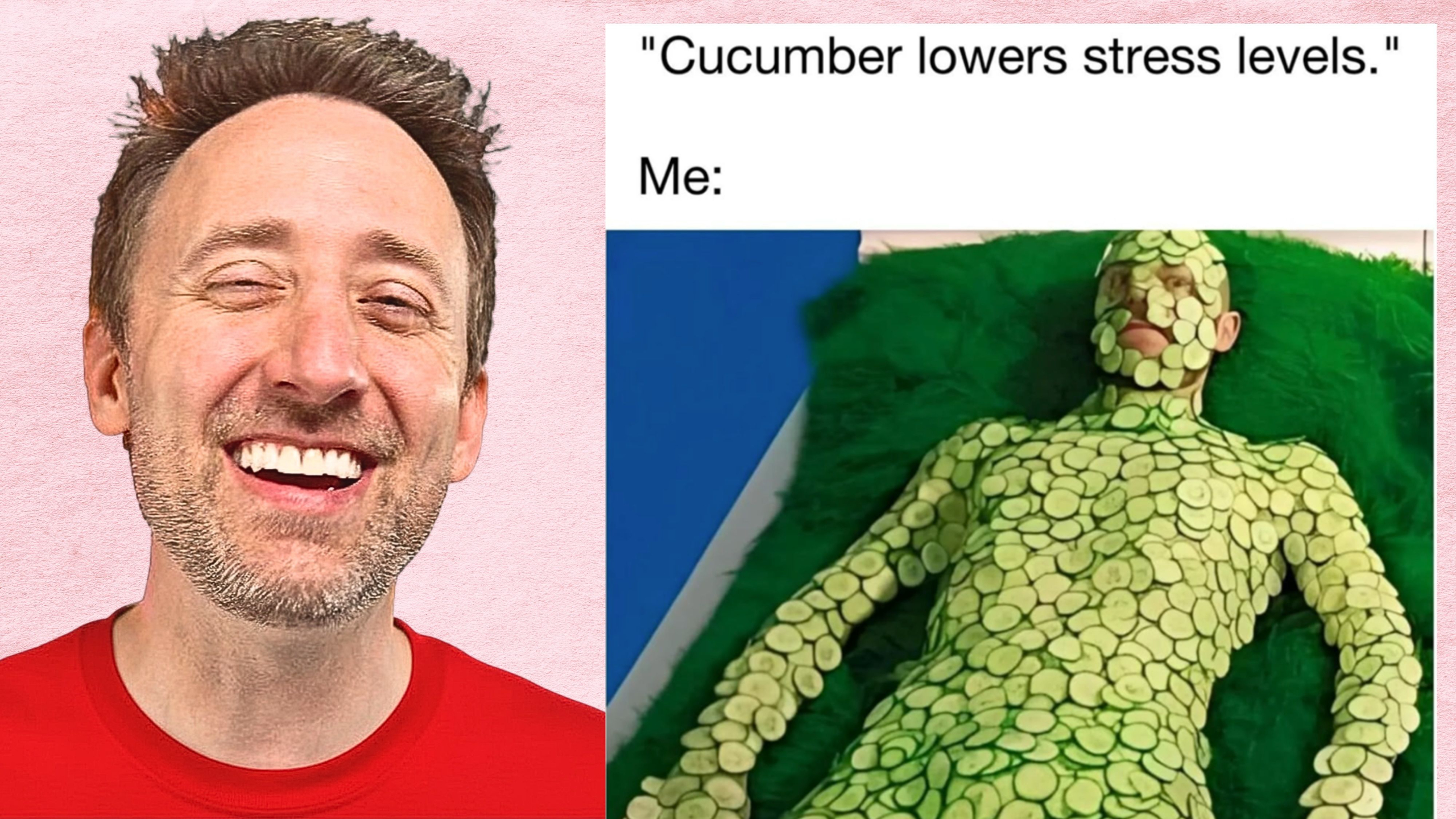
"Cucumber lowers stress levels." / "Me."
The second we find anything — oh, take the cucumber water. Oh, drink this. Oh, magnesium. And everyone's raving about it. Cool. Where are the success stories?
Look, magnesium is fine. Cucumbers are fine. But they're not treating anxiety or OCD. The evidence-based treatments are ERP and ACT — not wellness hacks. Don't let the internet convince you that a supplement is going to fix what therapy needs to fix.
MEME #8
"What I do at parties: Talk, eat, think about whether it's okay to leave yet"
I was thinking about when it was okay to leave before I even got to the party. Like, okay, here's my plan. I'm going to do this, eat this, and if I don't know anybody I'm going to sit in the corner. And that was before cell phone days, so I couldn't even pretend I was on my phone.
Even now, I'm more of a one-on-one person. If it's a big party, I'm like — get me out of here.
Planning your exit before you arrive is a classic anxiety move. It's a safety behavior — you're managing the discomfort before it even happens. The problem is it never lets you learn that you could have actually handled it.
MEME #9
"Anxiety is having 64 tabs open"
In real life I actually get bugged if I have more than a few tabs open. But you think about all these things we think about all the time.
One good tip: if you feel overloaded, pull out a piece of paper. Write down everything that feels like it's on your mind — all the to-dos, all the worries. Then put them in two categories:
- ✓ Things I have control over
- ✓ Things I have zero control over
You'll realize the things you actually have control over are pretty slim. Those are the ones worth focusing on. Everything else? Close the tab.
MEME #10
"Anxiety. Get ready to fight." "Fight what?" "Just get ready."
Fight or flight. Anxiety hits — something's happening, something's happening, you better get out of there or get ready to fight. A lot of times it's get out of there.
Don't you love when you feel anxious for no reason and your body just doesn't know what to do with it? That's your nervous system doing its job — badly. It's not broken. It's just miscalibrated. And the answer isn't to fight the anxiety or flee from it. It's to go with it. Let it be there. Maybe, maybe not.
MEME #11
"Go to the doctors for anxiety. Cancel because I'm too anxious to go."
Does anyone have health anxiety? People stress about going to the doctor so much they cancel. But then they're worried their health is bad. But they can't get themselves to go. Weird conundrum.
Get yourself there. Usually the anticipation is so much worse than the actual thing. That's true for most anxiety — the imagined version of the event is almost always scarier than the event itself. Your brain is a horror movie director. Reality is usually a lot more boring.
MEME #12
"My friend says just ask an employee." / "Me."
I would rather go to another store and see if I can find it instead of asking an employee. That's my social anxiety. Definitely gotten better.
Now — if I'm feeling anxious about it, I know I have to go ask. Even if I'm anxious. Even if they look busy. Even if I think they're going to be angry at me. That's my exposure.
If you feel anxious about something, go do it. That's a good lesson to live by — because we find it works out most of the time. The avoidance is what keeps the anxiety alive. The exposure is what shrinks it.
MEME #13
"I've got 99 problems and 86 of them are completely made-up scenarios I'm stressing about for no reason"
Goes back to that control exercise. If we're making up problems, our job is to say: not my thing. Not my thing.
Maybe, maybe not. Magic words. Any time you feel anxious and you don't see an immediate threat — maybe, maybe not. You don't need to solve a problem that doesn't exist yet. Wait for the problem to actually be there before you try to fix it.
MEME #14
"Random chest pain. Is this finally it?"
We go from zero to 100. Well, I guess my time's up. That can happen with anything.
Same answer: maybe, maybe not. Unless you're on the floor and can't move — we're not reacting to it. Catastrophizing turns a normal body sensation into a five-alarm emergency. Your body makes weird noises. That's allowed.
MEME #15
"Me overthinking. Me realizing I'm overthinking. Me thinking about overthinking. Me overthinking."
It's a pattern. We can't always control the way we're thinking — but we get to control how we respond to it. Can you give a different response than you normally would?
"Hey, man. Thanks for the thoughts. Awesome. Anything's possible. Sweet." With my overthinking, I just agree with pretty much everything. Yeah, that's probably going to happen. Okay. Are you sure you want to do this video? People are going to hate it. Hope so. The more I try not to engage with it — the more I actually get to live the life I want to live.
MEME #16
"I really need to tell you something." / "Me all night."
Why do people do that? "Come to my office, we need to talk" or "I've got to tell you something when we get home." Just tell me now. I'm going to be thinking about it all day.
Think about all those experiences. When you finally got to that conversation — was it as bad as you thought? Most of the time, not even close.
That shows us how easily our brain catastrophizes. Any threat that comes in — they're going to fire me, they're going to whatever — maybe, maybe not. Wait for the problem to actually be there before you try to solve it.
The Bottom Line
Anxiety memes are funny because they're true. There's something genuinely helpful about laughing at the chaos your brain puts you through — it creates a little distance between you and the thoughts. You're not the anxiety. You're the person observing it.
And if you noticed yourself in more than a few of these — especially the ones about reassurance, replaying interactions, or the loop that never ends — it might be worth looking into whether anxiety or OCD is playing a bigger role than you realized.
Take the free OCD and anxiety test — it takes about 3 minutes and gives you a clearer picture of what's going on.
Nathan Peterson, LCSW — Licensed therapist specializing in OCD, anxiety, and related conditions. Nathan has helped thousands of people through evidence-based treatment and education.
LCSW Licensed Therapist | 10,000+ Course Students | 24M+ YouTube Views | Penguin Random House Author
 |
Ready to actually do something about it?Master Your OCD is a step-by-step course built around ERP — the same approach I use with clients. It covers anxiety, OCD, and everything in between.
|
Author