Therapist Reacts to Fear Factor: Exposure Therapy or Trauma?
Mar 18, 2026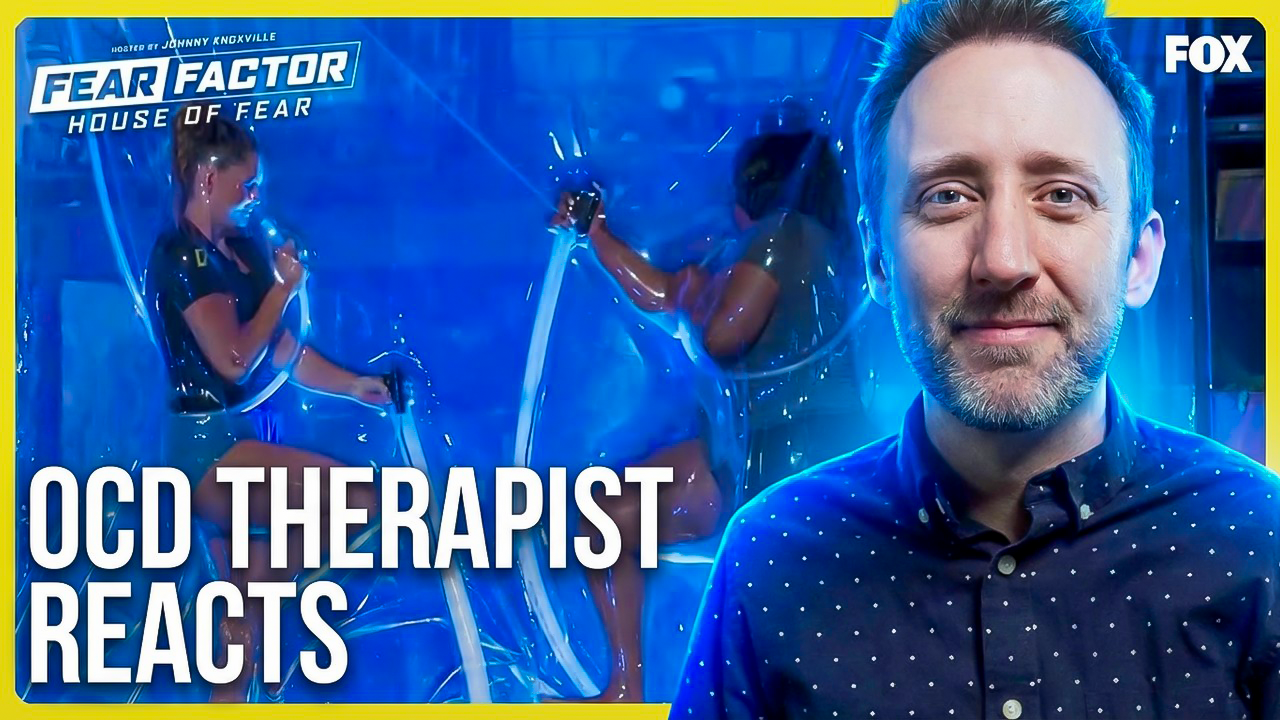
Therapist Reacts to Fear Factor: Exposure Therapy or Trauma?
Therapist Reacts to Fear Factor: Exposure Therapy or Trauma?
I'm a therapist who treats anxiety for a living, and I just watched people eat bugs for money on Fear Factor. Is the show helping people face their fears or just traumatizing them? Let's break down real exposure therapy vs. extreme challenges.
Is This What You Imagine Exposure Therapy Looks Like?
Snakes wrapped around your arm.
Rats in your mouth.
Being vacuum-sealed in a bag with the air sucked out.
Covered in hardening cement.
Jumping into dumpsters filled with garbage juice.
If you're going into exposure therapy and THIS is what you imagine, no wonder you're not going to therapy.
Good news: This is NOT what real exposure therapy looks like.
As a licensed clinical social worker specializing in anxiety and OCD treatment for over 15 years, I watched Fear Factor to see if they're actually helping people face fears—or just traumatizing them for entertainment.
Here's what I found.
Challenge #1: Snakes and Rats
The first challenge I watched involved contestants handling pythons and putting rats in their mouths.
People are screaming. Adrenaline pumping. Completely panicked.
Is This Exposure Therapy?
If you want to go extreme? Sure, jump into a pit of snakes.
But it's probably going to traumatize you—unless you know how to do it the right way.
What Proper Exposure Therapy Actually Looks Like
If someone said: "I'm afraid of rats and snakes," here's what we'd actually do:
- Think about one for a little bit
- Look at pictures
- Watch videos (watching Fear Factor could literally BE an exposure for someone)
- Draw pictures of them
- Gradually work up to being near them, touching them, etc.
We work ourselves up gradually.
Like acclimating to cold water when you jump in—it's going to feel cold, but it gets better.
The Problem With Extreme Exposure
On Fear Factor, contestants probably have so much adrenaline pumping through their veins they can't even think about what's going on.
"I just put this rat in my mouth. It's probably diseased. Who knows?"
They're in survival mode—not therapeutic processing mode.
Challenge #2: Vacuum-Sealed in Darkness
This one got me.
Contestants were stuck inside giant vacuum-sealed bags.
First, the air gets sucked out.
Then they must endure intense claustrophobia with barely any oxygen and can't move.
Oh, and then they turn off the lights.
My Personal Trigger
I noticed myself holding my breath watching this.
It reminded me of an experience I had as a kid at a water park.
I went to the wave pool and swam all the way to where the big waves come from.
Suddenly, the waves hit. People in inner tubes started crashing into each other.
My head was being smashed. I was pushed underwater.
All I could see were feet and tubes.
The second I got a breath—boom—knocked down again.
I thought it was over.
Someone grabbed me and pulled me out.
Is That Trauma?
I'll never forget that moment.
Anytime I can't breathe and have no control over it? Yeah, this triggers me.
How I'd Do Exposure for This (Safely)
If I were to do exposures for something like that, there are safe ways:
- Breathing through a straw
- Spinning around until you're out of breath
- Closing your eyes and imagining it
- Using VR simulations
But it's not just DOING it.
It's about what responses you're saying in the moment.
The Most Important Part: Your Response
If these people are in these bags thinking:
- "My organs are being smashed."
- "I can't breathe."
- "This is horrible."
They're reinforcing the fear.
What Therapeutic Exposure Sounds Like
Instead, you'd say:
- "I love this feeling."
- "I'm going to embrace it."
- "This is amazing."
- "I hope I pass out."
- "I hope I can't push that panic button. That would be pretty sweet."
This sends signals that say: "Maybe I'm not actually in as much danger as I think."
I know you're telling me I am. And there's always risk to everything.
But right now, I'm willing to risk it and see what happens.
The Panic Button = Compulsions
Fear Factor has a panic button.
Hit it and you'll be released immediately.
But you and your teammate will be at risk for elimination.
Sound Familiar?
That's exactly what compulsions are in OCD.
When anxiety feels overwhelming:
"I can't feel this anymore. I don't know what to do. It's just too overwhelming."
You hit the panic button (do the compulsion).
It seems like that rescue thing—temporary relief.
But guess what? It makes things worse later.
Challenge #3: Dumpster Diving in Garbage Juice
Contestants had to catch cow tongues dropped on them.
Then jump into dumpsters filled with disgusting brown water and garbage to find a match.
Contamination OCD Territory
You don't have to have contamination OCD for this to bother you.
This is very normal to bother anybody.
The Key to Contamination Exposures
When you're doing an exposure like this:
"Sometimes you just gotta do it and not think about it."
If you think about all the "what ifs" and possibilities—you're stuck.
He's got 30 seconds to find the match.
You're not thinking about what you're touching. You're just doing it.
After the Exposure
Typically after an exposure, we don't "fix" it:
- We don't wash our hands
- We don't shower immediately
- We don't mentally check
This might be one of those moments you'd want to shower.
But you could also choose not to—and delay it just a little while.
"Oh, I love this garbage juice."
My Verdict: Helping or Traumatizing?
All of these clips could be pretty traumatizing for somebody.
They know what they're doing on the show—it's entertainment.
What Real Exposure Therapy Looks Like
When you're going to face your fears in therapy:
It probably FEELS this absolute extreme.
But it's not.
You've got to:
- Trust the process
- Trust your therapist
- Do the treatment
Because it actually works.
Start off with something small and build up from that.
The Right Way to Do Exposures
Here's what makes exposure therapy therapeutic instead of traumatic:
1. Gradual Progression
Don't jump straight to your worst fear.
Build up slowly through a fear hierarchy.
2. Proper Responses
Use "maybe, maybe not" statements:
- "Maybe this rat is diseased. Maybe it's not."
- "Maybe this python will bite me. Maybe it won't."
- "I don't really know. And I'm okay with that."
3. Change Your Relationship With the Fear
Instead of: "This is horrible and I need it to stop"
Try: "What if I imagine myself floating? This is amazing. I love this feeling."
When you change your relationship with a fear, things go better.
4. Don't Use the Panic Button
Resist the compulsion.
Sit with the discomfort.
That's where the healing happens.
Final Thoughts
Fear Factor is entertaining.
But it's not a model for proper exposure therapy.
If you're avoiding treatment because you think it means jumping into your worst nightmare with no preparation—don't worry.
Real exposure therapy is gradual, controlled, and therapeutic.
Not traumatic.
Start small. Build up. Use the right responses.
Trust the process.
It works.
Nathan Peterson, LCSW
OCD and Anxiety Specialist
Creator of "OCD and Anxiety" YouTube Channel
Developer of Master Your OCD Online Course
Author