How to Stop Health Anxiety: Breaking the Checking Cycle
Dec 03, 2025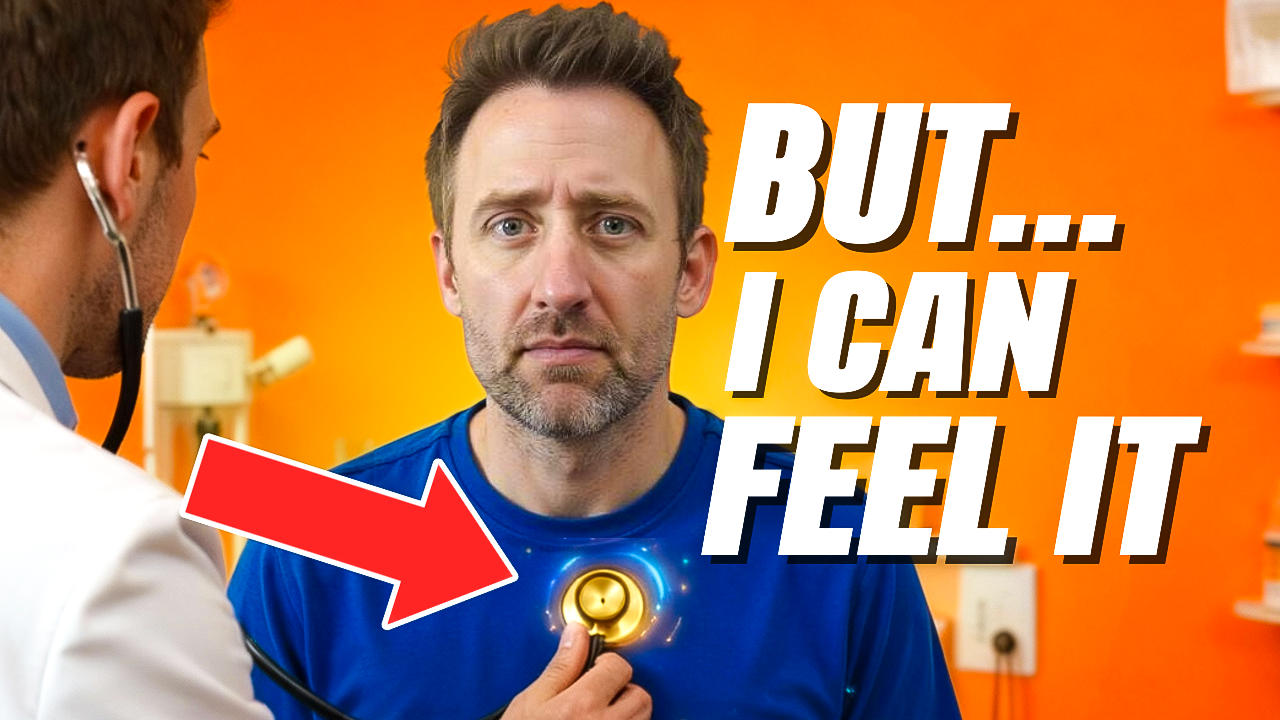
There I was, posting a video as normal, when all of a sudden I started receiving emails from people, DMs saying, "Hey, go see a doctor. I see something on your neck. You've got a lump on your neck." People were sending me screenshots with circles and arrows pointing to this supposed lump.
My first reaction? "What the freak?" I pulled up the video, and you know what? They were absolutely right. I could see a lump on my neck in the video.
So what does anyone do at this point? They go to the mirror. They check. They ask others if they see something. And even when you're pretty sure there's nothing there—when you don't see anything, don't feel anything—it doesn't matter. You still look up symptoms and signs. You start feeling like something is there, even though you're kind of sure it's not. But it's there on the video, so it's got to be there, right?
That's often where health anxiety pops into somebody's world.
My Personal Health Anxiety Spiral
What I noticed for myself is that I was asking my wife, "Are you sure you don't see something? I just got another email. Someone says there's a second video and it's on there too."
Guess what I found out? Pretty poor lighting. I don't know what happened that day, but a few videos I filmed, the lighting just gave me a really good shadow right on my neck. Awesome. But even though I knew that, I'm like, "I actually kind of feel something. I'm producing something there."
But then I realized—that's the problem. This is where I need to take what I teach everyone else for treatment and do it for myself. I need to stop checking. I need to stop feeling around for a problem. I need to stop researching.
And it's not as simple as just saying "stop it." Because in a few minutes, I'm going to teach you exactly what you do when you're stuck in this health anxiety trap.
The Core Truth About Health Anxiety
Here's the truth: the more you chase certainty about your health, the less certain you actually feel.
Let me break down that cycle so it makes sense to you. See if you fit into this pattern.
The Health Anxiety Cycle
Health anxiety begins with a normal sensation. Maybe your heart skips a beat. You feel a stabbing pain in your head. Someone sends you a message saying, "Hey, you got a lump."
Your brain interprets this as a threat. "What if it's something serious?" That thought triggers anxiety. You feel more symptoms because you're trying not to notice them. Your heart starts racing more. Your chest feels tighter. You start noticing pains that you didn't notice before, but they've always been there.
So we start panicking. When you notice a sensation, the brain automatically jumps to "must be dangerous." You're still feeling it, so the mistake that a lot of people make is thinking, "I'm just being cautious. I'm just being what everyone else would do."
But then you realize: "I've checked my pulse like 50 times today. I'm taking a picture of my neck where they said that lump was, and I'm going to keep analyzing it. I'm going to ask the next person because the last five people said they didn't see it, but what if the sixth person does?"
You think you're being responsible, but actually you're keeping it alive.
What Treatment Really Comes Down To
Really, what treatment comes down to is being okay knowing that I don't know everything, and I can handle uncertainty about my own health. Because the truth is, hardly anyone—if anyone—is perfectly certain about their health.
Even doctors feel aches and twinges that they can't explain. So that illusion of "if I just check one more time, I'll finally know" keeps you stuck in that anxiety rather than protecting you.
How to Actually Stop This: ERP for Health Anxiety
This is where I use Exposure and Response Prevention. ERP teaches your brain that these sensations maybe aren't threats—they're just feelings.
The Exposure Part
The exposure part means I'm deliberately allowing myself to feel an emotion, notice something. I might be purposely going towards a threat, something that I'm worried about.
For example: "I'm so worried about this lump on my neck that I think is on my neck that I'm going to write the word 'lump' on a piece of paper. I'm going to say lump lump lump lump lump lump neck on my neck. Lump lump on my neck."
And I'm saying "maybe, maybe not." I'm using some phrases of uncertainty. Maybe I got a lump, maybe I don't. Maybe everyone's missing it, maybe not.
Getting to the Core Fear
But I also have to figure out: what am I actually worried about if I have a lump or if I have cancer or whatever the fear is? Am I worried about death?
So let me switch some of those uncertainty phrases to death-related ones. "Maybe I'll miss this lump and I'll end up dying. Maybe I'll feel like I'm not responsible and I'll leave my family."
Those are pretty heavy statements to say, but I've got to teach my brain to keep moving on because there is a normal level of checking our health and making sure we're okay. And then when anxiety jumps into the picture with a lot of compulsions—things that we're doing to make sure—it's no longer a responsible thing.
Examples of Health Anxiety Exposures
So we've got that exposure part where people are facing these uncertainties on purpose:
If I'm worried about my heart, I'm doing a bunch of jumping jacks. Worried about skin cancer? I'm going to go sit in my backyard for five seconds and come back in. Worried about whatever disease? I'm going to be watching videos about it, drawing pictures.
Sounds ridiculous, I know. But we want that anxiety to spike. We want you to stay with it. Practice not checking. Practice not saying "Oh, I have something for sure" in a scared way. We're using those uncertainty phrases, and then we're living life in the moment.
How to Know When It's Time to See a Doctor
Even if you feel something and you think you have something—and I can hear you on the other side of this saying, "What if you actually miss something, though? I can't believe you're telling people to not get it checked"—no, you're missing the point.
We don't have to be too relaxed, but people think they're not being responsible, so they're going to get back into checking.
When It's Obvious
So how do you know when it's time to take something seriously? You know because it is absolutely obvious.
When I got those messages saying "You have a lump on your neck" and I felt right there and I'm like, "You know what? I actually feel something. I see something," and my spouse who I asked said, "Yep, there's something there," then I would schedule a doctor's appointment and get it checked out.
But in my case, I don't feel anything. I don't see anything. My body is actually making me feel sometimes something there. I got a verification one time. I'm still not 100% sure. Maybe it comes and goes. Maybe there's information I don't know about it. I'm going to actually wait for my next physical to go get that checked out because we don't have to go into problem-solving mode for everything.
The Big Red Flag
Here's a big red flag for you: If you're worried about the same thing—same disease, same whatever health concern—and you're thinking about it day after day after day, and there hasn't been some really good evidence (like really good evidence), and you're still worried about it, and you're still doing behaviors to check, you know something else is happening. There's that health anxiety that's probably going on.
So you might have to commit to yourself: no matter what, I am not figuring this out unless it is so absolutely obvious and it just slaps me in the face.
My Obvious Moment: When I Actually Needed the Doctor
But here's the thing—I can't tell you not to go see a doctor. You've got to make your own decisions. That's my little disclaimer there. But you want to hear my obvious moment where I actually needed to go to the doctor?
Here I am waking up in the middle of the night. My heart literally is shaking. Shaking. I can feel it. It's almost like you have one of those game controllers and it was just on my chest like this, shaking. And I was like, "What the freak is happening?"
I'm sitting there and then it went away and I'm like, "Okay, well that was weird. Cool, move on with my day." Then it happened again. Then it happened again. And then I'm like, "You know what? I can't work out anymore because it's happening." I literally can't even walk up the stairs to go say goodnight to my kids.
Okay, there's something happening. And this was all happening without me really checking like "why is my heart doing that?" I still remember the feeling of literally crawling up the stairs so I could say goodnight to my kids because I could not walk up the stairs. It was that obvious.
The Diagnosis
What ended up happening? I have SVT—supraventricular tachycardia. Parts of my heart were out of rhythm and I had to get an ablation where they had to put some lines up in me and shock different parts of my heart to get me back into rhythm.
Went to the doctor, got the EKG, they checked out what was going on, and they're like, "This is what you need. This is what you do. Go get it." All done. "You might have it again in the future," is what they said.
Okay, guess my job is to keep moving on with life. There was a problem. We solved it. We're moving on. There's still uncertainty about it, but that's okay.
Health Anxiety Is Not Cured by Checking
Again, health anxiety is not cured by checking. It's retraining your brain to say, "I know I feel these sensations because I did." After the doctor said, "You're probably going to feel this again at some point, maybe multiple times," my brain automatically says, "Let me notice my heart." And I felt things that probably actually weren't there.
Our natural reaction as human beings is to keep ourselves alive. And I feel like our anxiety hijacks that moment and says, "You've got to keep yourself alive. Let me have you worry about all these possibilities. Oh, you just learned about this new thing. You've got to make sure you don't have it."
No, that's not how life is supposed to be.
Living According to Your Values
What are your values? What are your goals? Let's move towards those. If it's family, let's go hang out with family. If it's church, go to church. You don't have to be perfectly calm. You can feel anxious and keep living life.
The time where you're just like, "Oh yeah, maybe my heart's out of whack. I don't know. Maybe." Cool. Hope so. That'd be awesome. Great. Cool. Whatever phrases I can give to take that value away.
Your brain's learning from that and saying, "Wait a second, if you're not freaked out, I don't need to be freaked out." So you are controlling it. You get to decide what you're teaching your brain.
But if you go into problem-solving mode, your brain's like, "This was a problem. Thank you for letting me know. I'm going to bring it back to your attention."
Your Challenge: What Will You Stop Checking?
Here's what I want you to do. Think of a habit that you have, something that you're checking—maybe it's not even health-related—and you're like, "Today I am not checking that." And every time you're worried about it, every time, smile. "Yeah, maybe." See what happens.
Because you're going to start breaking these walls down that feel like you're trapped. And you can say "maybe" for everything.
"What if I'm missing something and I'm just being irresponsible?" Yeah, maybe.
"But I actually feel something." Yeah, maybe.
There are points where we say, "I'm going to the doctor. Whatever they say is what they say, and I've got to go with it. Maybe they were wrong, maybe they were right, but that is my guideline." Hey, once a year going to the doctor—I'm golden. That's all I'm doing, unless it is super obvious.
So what is your thing that you are going to stop doing today? Because your job is to start living.
What's the point of trying to make sure you live a long time and not have health problems if you're not actually living?
Author